
Insights
Airbnb’s NEW Pricing Tool - Should You Use It?
Airbnb has launched a new pricing tool for hosts, which enables them to compare prices between their own listings and those of other hosts, thereby assisting them in setting calendar prices.
To evaluate the potential benefits of this tool on hosts' annual earnings, Airbooster conducted a comprehensive analysis.
Our findings indicate that caution must be exercised when examining "competitors" through this tool, as it can be misleading.
Airbnb has released a “new pricing tool to compare similar listings nearby” among its May 2023 upgrades for hosts.
We decided to test the tool on a Newtown 2-bedroom house for the winter school holidays dates of 6-9 July 2023 (3 nights, Thursday to Sunday) - two months into the future from the date of our test.
The big question: is comparing your prices with nearby properties a good way to improve your revenue? This is how most hosts work out how to set their calendar prices, and initially this looks logical - BUT our results found this could be misleading technique.
Booked Listings
The first display was for "Booked Listings," and the Airbnb pricing tool showed our home for $526, along with seven other listings which had average nightly rates ranging from $259 to $449. The furthest away was a listing in Petersham, which was a 12-minute drive or 5 kilometers away. However, some guests might not consider it the neighborhood they were targeting.
Is This Useful or Not?
While it was interesting to view the prices of listings that had been booked out months in advance, Airbooster typically would not use this information. We have a deliberate technique of not getting booked out too far in the future, especially for peak periods like school holidays.
Our perspective is that many hosts who are already booked out in high-demand times have probably "sold out too early" where the cheapest places tend to get booked first. However, these are not the places we want to compete with if our goal is to earn optimal annual revenue.
Although some hosts believe they have done well because they have "occupancy," they may have actually underpriced their listing.
It could be interesting to view a booked property at a closer date, but the tool has a limitation: it doesn't show when the booking took place. The listing may have been underpriced and sold out too early, or it may have been booked just yesterday (which would be useful information). Unfortunately, the tool does not provide this data.
Unbooked Listings
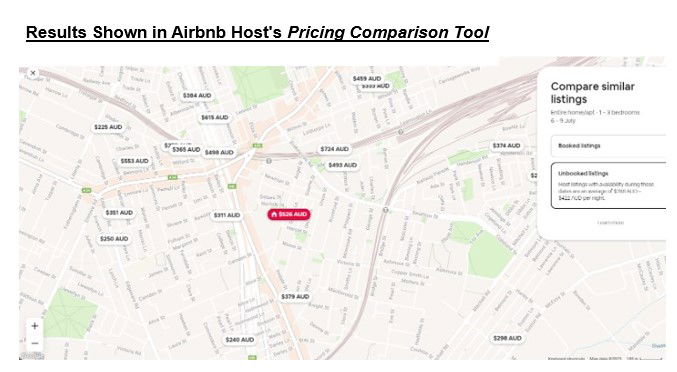
The second comparison was for "Unbooked Listings," where the Airbnb map tool displayed 18 listings. These listings had average night rates ranging from $225 to $724. The farthest listing was approximately 2.6km away (an 8-minute drive) in Alexandria.
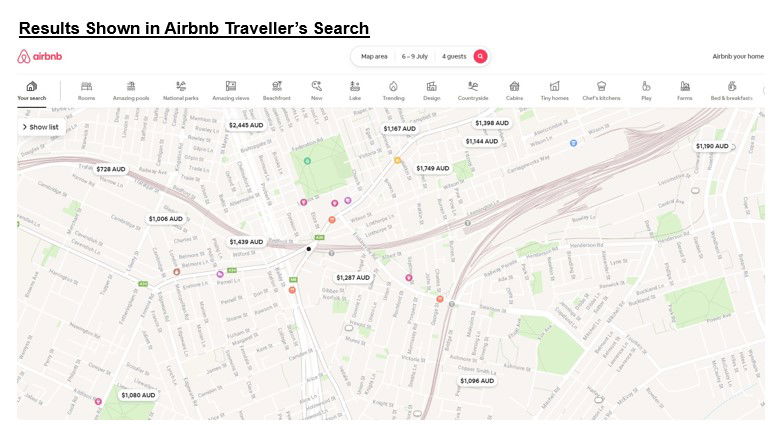
To conduct an additional test, we logged into Airbnb incognito as a traveler and searched for 2-bedroom properties in Newtown for the same dates (6-9 July). The traveler's search results showed 31 listings. However, since it displayed the total price for a 3-night stay, we had to click on each listing to find the average night rate.
Hosts are Shown Lower Prices
The main concern was that the tool displayed a lower rate to hosts compared to what travelers saw for identical listings.
Prices, on average, were 8% lower in the host tool compared to the prices shown in the traveler results. The largest discrepancy observed was 22% lower than the traveler's rate for the same listing. There were no instances where the host tool displayed higher nightly rates than the guest search rates for the same property; only lower rates were shown.
Unfortunately, it appears that Airbnb may be deliberately attempting to drive down the prices set by hosts.
Additionally, different properties were shown between the host tool and guest search results. Airbnb claims to display listings similar to the host's property based on factors such as "location, size, features, amenities, ratings, and reviews." However, we were unable to identify a pattern to explain the varying results. For example, our Newtown house has a rating of 4.9+ with over 120 reviews, but the host tool displayed many properties with fewer than 10 reviews and some with ratings below 4.5.
If you choose to set prices based on nearby properties, it would be preferable to conduct a traveler search or risk underpricing. Select properties with similar sizes, amenities, and use the desired dates to ensure accuracy."
Is Comparing Nearby Properties A Useful Strategy?
Setting your prices based on nearby listings is an attractive idea, but it can be misleading unless you tread carefully. The rates you see for neighboring properties may not be typical due to fluctuations caused by surge or peak/low season prices, as well as weekday/weekend prices.
To achieve optimal revenue, you need to monitor the entire year. If you rely solely on nearby listing prices that happen to be high or low, you may end up setting your own listing price too high or low, unless you regularly monitor them, ideally on a weekly basis at the very least.
Further - the rate you see on your competitor's listing may not be the rate paid when booked. For instance, many hosts set extremely high rates for peak seasons months into the future. However, if the property remains vacant close to the search date, prices may be discounted.
When comparing your listing, it should only be done with places that have a similar number of reviews and ratings. Generally, newer hosts with fewer reviews tend to earn less than longer-standing hosts. Guests typically choose properties with more reviews, and high-review properties also rank higher in search results, leading to higher bookings.
Hosts should compare their listings with properties that offer similar amenities. By utilising basic amenities as search filters—such as Wi-Fi, Kitchen, Washing machine, Iron, and Dryer—the number of listings narrowed down from 31 to 18 properties in our two-bedroom Newtown search. If your property has more or fewer of these amenities, it can influence your price to be higher or lower compared to nearby listings.
Airbooster offers a more advanced way of improving your pricing and revenue. Our approach is completely different—we analyse the actual annual revenue of a group of very similar listings to determine the income range in your area. Based on this analysis, we develop a pricing strategy to improve your listing's ranking within this group. Our goal is to place your listing in the top 25% of comparative properties in terms of annual revenue.
We judge how much improvement can be made - and NOT the other way around of looking at other listings’ random prices to see where your price should be!
Many hosts work out their rates by looking at the prices of nearby listings. But is this approach effective in maximising your annual revenue?
Estimating your potential Airbnb revenue may appear to be a guessing game - but Airbooster will provide you with a realistic appraisal of your potential earnings based on nearby Airbnb properties that directly compete with your property.
One of the biggest myths among Airbnb hosts is they accept a ‘market rate’ for their property. What most don’t realise is that some hosts earn two or even three times more than other similar listings nearby.
If a guest gives you less than five stars for a stay, can this affect your annual revenue?
Airbooster tested whether the number of reviews or the rating score of a listing could affect annual earnings.
Let's get in touch

Copyright 2023 AirBooster